Costus Root | Traditional Herbal Medicines
🌿 Costus Root – A TCM Herb for Regulating Qi, Relieving Abdominal Fullness, and Supporting Digestion
Costus Root, known as Mộc hương in Vietnamese, is a traditional herb commonly used in TCM to regulate Qi, relieve abdominal fullness and pain, and support digestion. Because it helps regulate Qi movement in the Spleen and Stomach, the herb is frequently included in formulas for indigestion, poor appetite, bloating, and abdominal discomfort associated with Qi stagnation.

Costus Root – a traditional herb for regulating Qi and supporting digestion
- Scientific name / Pinyin / Chinese: Radix Saussureae lappae / Mu Xiang / 木香.
- Flavors, Nature – Meridian: Pungent, Bitter, Warm – associated with the Spleen, Stomach, and Large Intestine Meridians.
- Main benefits: Traditionally used to regulate Qi, relieve abdominal discomfort and bloating, and support digestive function.
- Reference dosage: Commonly 3–9 g daily, usually prepared as a decoction.
1. Origin and description
Costus Root is the dried root of a perennial herb in the Asteraceae family. The plant originates from the Himalayan region and has traditionally been cultivated in China, India, and other areas with cooler climates.
The plant can grow about 1–2 meters tall. It has large alternate leaves with serrated margins, while the flowers are usually purple to light purple and grow in clusters near the ends of the stems.
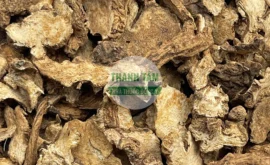
The roots are harvested when the plant reaches maturity. After collection, they are cleaned, cut into sections or slices, and dried for medicinal use. The dried root is cylindrical, yellow-brown to dark brown, and has a strong characteristic aromatic fragrance.
Good-quality material should have a clear aroma, firm texture, natural brown coloration, and no visible mold or unusual odor.
2. Related names of Costus Root
Other names: Mộc hương, Quảng mộc hương, Vân mộc hương, Xuyên mộc hương, Costus Root, Saussurea Root.
Scientific name: Radix Saussureae lappae.
Pinyin name: Mu Xiang.
Chinese name: 木香.
Because related herbal materials may share similar names, correct botanical identification is important.
3. Flavors, Nature – Meridian
In TCM, Costus Root is described as having Pungent and Bitter flavors with a Warm nature. It is traditionally associated with the Spleen, Stomach, and Large Intestine Meridians.
The Pungent flavor is traditionally linked with moving Qi and relieving stagnation. The Bitter flavor helps direct Qi downward, while the Warm nature supports Cold-related digestive patterns.
Through the Spleen and Stomach Meridians, the herb is used to regulate the digestive Qi mechanism and ease fullness, poor appetite, and abdominal pain. Its Large Intestine association relates to regulating intestinal Qi and supporting bowel function.
4. Benefits of Costus Root in TCM
In TCM, the herb belongs to the category of Qi-regulating herbs and is commonly used for digestive discomfort related to Qi stagnation. Traditional applications include:
- Regulating Qi: Traditionally used when Qi stagnation causes abdominal fullness, pressure, or discomfort.
- Relieving abdominal pain: May be included in formulas for cramping or pain related to impaired Qi movement.
- Supporting digestion: Often combined with other herbs for indigestion, poor digestive function, and reduced appetite.
- Reducing bloating: Traditionally used when fullness and gas occur after eating.
- Supporting gastrointestinal balance: May be included in formulas for digestive irregularity when the overall TCM pattern is appropriate.
These uses belong to the TCM framework. Persistent abdominal pain, unexplained weight loss, blood in the stool, or ongoing symptoms should be medically evaluated.
5. How to use and dosage
Costus Root may be prepared in several traditional ways:
- Decoction: A commonly referenced dosage is 3–9 g daily.
- Powder: The dried root may be ground into a fine powder and taken according to an appropriate traditional formula.
- Herbal combinations: Often paired with Sha Ren, Chen Pi, or other Qi-regulating and digestive herbs.
Because its aromatic components are valued, the herb is sometimes added late in decoction. Dosage and preparation should match the formula and individual constitution.
6. Indications and contraindications
Indications
In traditional practice, Costus Root may be referenced for abdominal fullness, poor digestion, abdominal pain related to Qi stagnation, reduced appetite, bloating, and other digestive discomforts associated with impaired Qi movement.
Contraindications and precautions
People with Yin deficiency and excessive Heat should use caution. Those with severe constipation or pronounced dryness should also avoid unsupervised use when the herb does not match the overall pattern.
Pregnant or breastfeeding individuals, children, and people taking regular medication should consult a healthcare professional or Herb doctor before use.
Seek medical attention if abdominal pain is severe or persistent, or if it is accompanied by repeated vomiting, fever, black stools, blood in the stool, dehydration, or unexplained weight loss.
7. Reference herbal combinations with Mộc hương
- Bloating and indigestion: Costus Root + Chen Pi + Sha Ren. Traditionally used to regulate Qi and support food digestion.
- Abdominal pain due to Qi stagnation: Costus Root + Zhi Ke + Xiang Fu. Traditionally used to regulate Qi and relieve discomfort.
- Poor digestion and reduced appetite: Costus Root + Bai Zhu + Fu Ling. Traditionally used to strengthen the Spleen and support digestion.
- Abdominal bloating and gas: Costus Root + Sha Ren + Shen Qu. Traditionally used to regulate Qi and reduce food stagnation.
- Dysentery-like symptoms with blood, mucus, and tenesmus: Classical references combine Mu Xiang with Bai Shao, Dang Gui, Da Huang, Huang Qin, Huang Lian, and Bing Lang. Such formulas require professional assessment and should not be self-prescribed.
These combinations are for traditional reference only. Formula and dosage should be adjusted according to symptoms, constitution, and professional guidance.
8. Frequently asked questions
- Is Costus Root traditionally used for digestion? Yes. It is commonly used in TCM formulas to regulate Qi, relieve bloating, and support digestive function.
- What is the usual daily dosage? A commonly referenced dosage is 3–9 g daily, usually prepared as part of a decoction or herbal formula.
- Can it be used for poor appetite? It may be included in appropriate formulas when reduced appetite is associated with Qi stagnation or digestive weakness.
- Can it be used long term? Prolonged self-use is not recommended. Regular use should consider the individual’s constitution.
- How should good-quality material be selected? Choose dry root with a strong natural aroma, firm texture, normal brown coloration, no mold, no unusual odor, and a clearly identified source.
👉 Visit Thanh Tam Herbs – a trusted Herbal pharmacy for quality herbs and TCM guidance
Nguồn tham khảo
- Dược điển Việt Nam.
- Lương y Hy Lãn Hoàng Văn Vinh, Cây thuốc vị thuốc Đông y, Nhà xuất bản Hà Nội, 2001.
- Tài liệu, hướng dẫn và thông tin chuyên ngành từ Bộ Y tế.
Rate this article
How useful was this article?
Tác giả bài viết