Desmodium Herb | Traditional Herbal Medicines
🌿 Desmodium Herb – A TCM Herb for Promoting Urination, Clearing Heat, and Supporting Urinary Stones
Desmodium Herb, known as Kim tiền thảo in Vietnamese, is a familiar medicinal herb traditionally used in TCM for promoting urination, clearing Heat, draining Dampness, and supporting the passage of urinary or biliary stones. Because of its traditional actions of promoting urination and addressing Damp-Heat patterns, the herb is commonly included in formulas for urinary discomfort and certain Liver and Gallbladder conditions.
- Scientific name / Pinyin / Chinese: Desmodium styracifolium / Jin Qian Cao / 金钱草.
- Flavors, Nature – Meridian: Sweet, Bland, Cool – associated with the Liver, Gallbladder, Kidney, and Bladder Meridians.
- Main benefits: Promotes urination, clears Heat, drains Dampness, supports urinary flow, and is traditionally used in stone-related patterns.
- Reference dosage: Commonly 15–60 g daily as a decoction.
1. Origin and description
Desmodium Herb refers to the dried aerial parts of Desmodium styracifolium, a plant in the Fabaceae family. The herb is usually harvested during its active growing season, cleaned, and dried for medicinal use.
It is a low-growing herb with creeping stems. Its small, rounded leaves resemble coins, which is reflected in the Vietnamese name “Kim tiền thảo,” meaning approximately “money coin herb.” The flowers are small and may range from pale purple to light yellow, depending on growing conditions.
The plant is commonly found in moist soil, grasslands, stream banks, roadsides, and other humid environments in Vietnam and other parts of Asia.
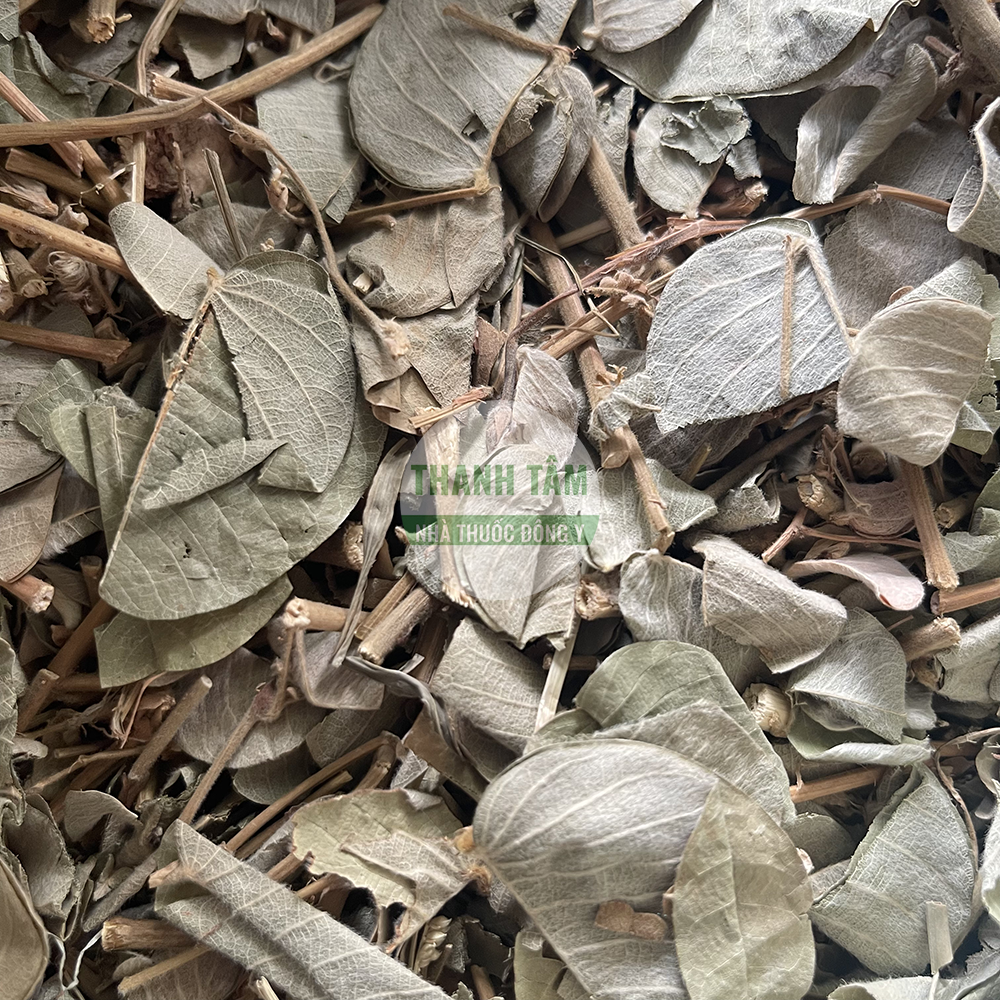
After drying, the medicinal material is usually greenish brown, with slender stems, a mild odor, and a slightly Sweet, Bland taste. Good-quality material should be clean, naturally colored, dry, and free from mold, excessive moisture, or foreign matter.
2. Related names of Desmodium Herb
Other names: Kim tiền thảo, Đồng tiền thảo, Cỏ đồng tiền, Bài tiền thảo, Điệp tiền thảo, Desmodium Herb, Coin-leaf Desmodium.
Scientific name: Desmodium styracifolium.
Pinyin name: Jin Qian Cao.
Chinese name: 金钱草.
The common name Jin Qian Cao may refer to different botanical sources in regional herbal traditions. For this article, the medicinal material specifically refers to Desmodium styracifolium. Buyers should therefore verify the botanical name and source when selecting the herb.
3. Flavors, Nature – Meridian
In traditional herbal practice, this herb has a Sweet and Bland flavor with a Cool nature. It is traditionally associated with the Liver, Gallbladder, Kidney, and Bladder Meridians.
Its Bland quality is traditionally linked with promoting urination and draining Dampness, while its Cool nature is associated with clearing Heat.
The Liver and Gallbladder associations are traditionally related to Damp-Heat and biliary patterns, while the Kidney and Bladder associations explain its frequent use for urinary discomfort. These are TCM concepts and should not be interpreted as direct modern medical mechanisms.
4. Benefits of Desmodium Herb in TCM
Common traditional uses include:
- Promoting urination: Often included in formulas for reduced urine output, urinary discomfort, or Damp-Heat affecting the urinary tract.
- Clearing Heat and draining Dampness: Traditionally used when symptoms are interpreted as Heat or Damp-Heat patterns.
- Supporting urinary stone passage: Frequently included in traditional formulas for kidney or urinary stones, especially when accompanied by painful or difficult urination.
- Supporting biliary stone patterns: May be combined with other herbs in formulas for Gallbladder Damp-Heat and certain stone-related presentations.
- Supporting painful or frequent urination: Used traditionally when urination is uncomfortable, frequent, or accompanied by a burning sensation.
These benefits belong to the TCM framework. Urinary stones, gallstones, urinary tract infections, or persistent abdominal or flank pain require proper medical assessment.
5. How to use and dosage
A commonly referenced dosage is 15–60 g daily, usually prepared as a decoction. The actual dose may vary according to the formula, botanical source, individual constitution, and treatment purpose.
The herb may also be prepared as a herbal infusion or combined with other herbs such as Diệp hạ châu and Gan Cao.
Although it is sometimes consumed as herbal tea, continuous long-term self-use is not recommended. People taking diuretics, blood pressure medication, or medicines affecting kidney function should consult a healthcare professional or Herb doctor first.
6. Indications and contraindications
Indications
Traditional references describe use for kidney or urinary stones, gallstone-related patterns, painful or frequent urination, urinary difficulty, and certain Damp-Heat patterns involving the urinary or hepatobiliary systems.
Contraindications and precautions
People with Spleen and Stomach Cold-deficiency, frequent urination not caused by Damp-Heat, dehydration, or low blood pressure should use caution.
Anyone with kidney disease, recurrent urinary infections, or known gallstones should not rely on herbal treatment alone.
Seek medical care promptly for severe flank or abdominal pain, fever with urinary symptoms, blood in the urine, inability to urinate, persistent vomiting, jaundice, or rapidly worsening symptoms.
7. Reference herbal combinations with Kim tiền thảo
- Kidney and urinary stone support: Kim tiền thảo may be combined with corn silk and Che Qian Zi in traditional formulas intended to promote urination and support stone passage.
- Gallstones with mild jaundice: Traditional combinations may include Yin Chen and Zhi Zi when Damp-Heat signs are present.
- Painful or frequent urination: It may be combined with Bian Xu and Plantain Herb according to the overall pattern.
- Clearing Heat and supporting detoxification: Traditional formulas may combine it with Diệp hạ châu and Gan Cao.
- Urinary Damp-Heat patterns: It may be paired with Huang Bai and Ze Xie when professionally indicated.
These combinations are for reference only. Formula composition and dosage should be adjusted according to symptoms, constitution, medications, stone location, and professional assessment.
8. Frequently asked questions
- Can Kim tiền thảo dissolve kidney stones? In TCM, it is traditionally used to support stone passage and urinary flow. It should not be considered a guaranteed stone-dissolving treatment, and stone size and location should be medically assessed.
- Can it be used every day? Daily long-term self-use is not recommended. The appropriate duration depends on the condition, dosage, constitution, and other medications.
- Is this herb considered cooling? Yes. In TCM, it has a Cool nature and is traditionally used to clear Heat and drain Dampness.
- What is the usual daily dosage? A commonly referenced range is 15–60 g per day as a decoction, although the actual amount depends on the formula.
- Can it be used for gallstones? It appears in traditional formulas for certain Gallbladder Damp-Heat and stone-related patterns, but gallstones can cause serious complications and require proper diagnosis.
- How long does it take to work? There is no fixed duration. Response depends on the underlying condition, stone characteristics, formula, constitution, and treatment plan.
👉 Visit Thanh Tam Herbs – a trusted Herbal pharmacy for quality herbs and TCM guidance
Nguồn tham khảo
- Dược điển Việt Nam.
- Lương y Hy Lãn Hoàng Văn Vinh, Cây thuốc vị thuốc Đông y, Nhà xuất bản Hà Nội, 2001.
- Tài liệu, hướng dẫn và thông tin chuyên ngành từ Bộ Y tế.
Rate this article
How useful was this article?
Tác giả bài viết