Safflower | Traditional Herbal Medicines
🌿 Safflower – A TCM Herb for Invigorating Blood, Dispelling Stasis, and Supporting Pain Relief
Safflower, known as Hồng hoa or Hong Hua, is the dried flower of Carthamus tinctorius L. In TCM, it has a Pungent flavor and a Warm nature. It is traditionally used to invigorate Blood, promote menstruation, dispel Blood Stasis, and support pain relief when appropriate for the individual pattern.
- Scientific name / Pinyin / Chinese: Carthami Flos / Hong Hua / 红花.
- Flavors, Nature – Meridian: Pungent, Warm; associated with the Heart and Liver Meridians.
- Main benefits: Traditionally invigorates Blood, promotes menstruation, disperses Blood Stasis, and supports pain relief.
- Reference dosage: 4–12 g daily, commonly prepared as a decoction.
1. Origin and description
The medicinal material is the dried flower of Carthamus tinctorius L., an herbaceous plant in the Asteraceae family. The plant is generally about 0.6–1 m tall, with an upright stem that branches near the top. The leaves grow alternately and may have toothed or sharply pointed margins. Flower heads grow at the ends of the branches, initially appearing yellow-orange before becoming red.
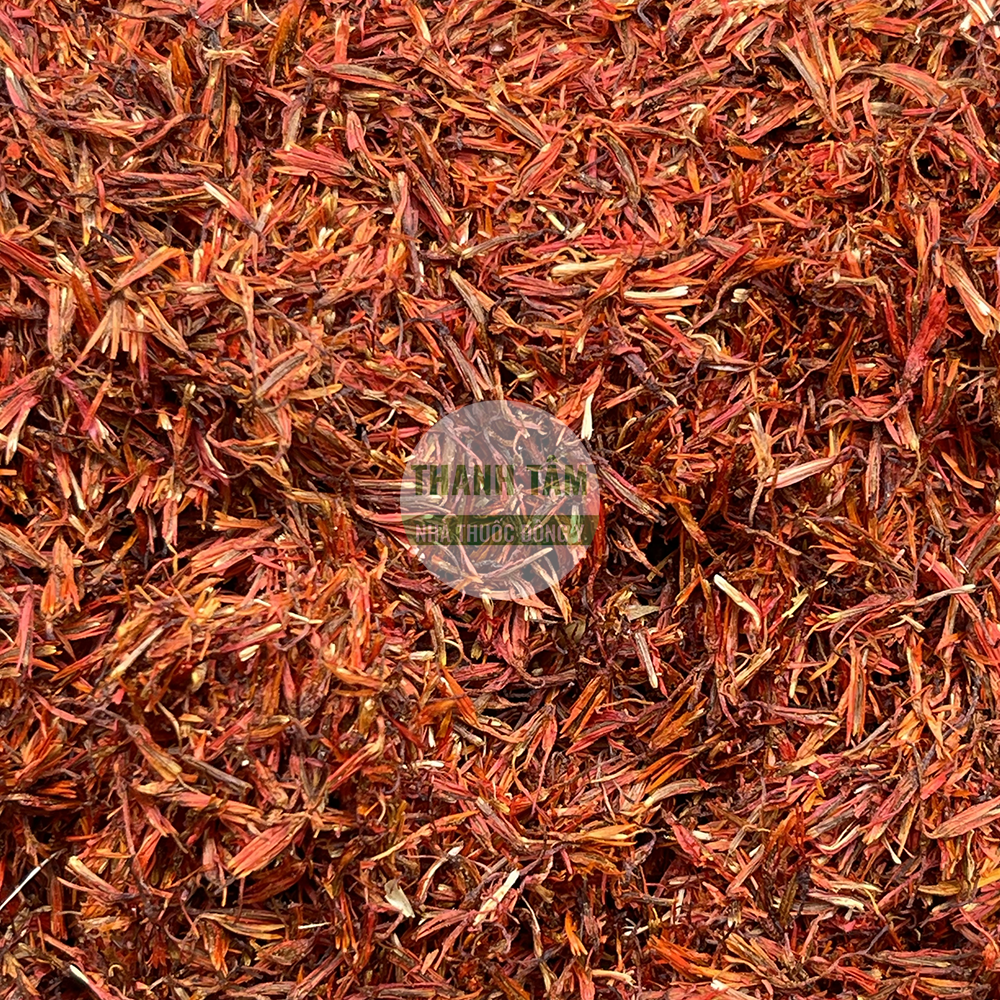
According to the Vietnamese Pharmacopoeia, the medicinal flowers are about 1–2 cm long and usually yellow-red or red on the outer surface. The tubular corolla divides into five narrow lobes near the top. The dried material is soft, lightly aromatic, and slightly bitter.
The flowers are commonly harvested in summer as they bloom and change color, then dried in a shaded, well-ventilated place or under gentle sunlight. Store the herb in a cool, dry environment and protect it from moisture and mold. Do not use material with unusual discoloration, an unpleasant odor, or visible fungal growth.
2. Related names of Safflower
Other names: Hồng hoa, Hoa rum, Hồng lam hoa, cây rum, Safflower, Safflower Flower, Hong Hua.
Scientific name: Flos Carthami tinctorii.
Pinyin name: Hong Hua.
Chinese name: 红花.
This herb should not be confused with saffron, sometimes called Tây hồng hoa in Vietnamese. Saffron consists of the dried stigmas of Crocus sativus, while Safflower is obtained from the flowers of Carthamus tinctorius. They differ in botanical origin, medicinal part, traditional use, and preparation.
3. Flavors, Nature – Meridian
According to the Vietnamese Pharmacopoeia, the herb has a Pungent flavor and a Warm nature and is associated with the Heart and Liver Meridians.
In TCM theory, these qualities are traditionally linked with promoting the movement of Blood and helping resolve stagnation. The Heart and Liver Meridians are commonly discussed in relation to Blood circulation, menstruation, and pain patterns caused by Blood Stasis.
These descriptions belong to the traditional TCM framework and should not be interpreted as modern biomedical mechanisms.
4. Benefits of Safflower in TCM
Common traditional uses include:
- Invigorating Blood and promoting menstruation: Often included in formulas for amenorrhea, irregular menstruation, or menstrual pain associated with Blood Stasis.
- Dispelling Blood Stasis: Traditionally used when signs of stagnation include menstrual clots or fixed, localized pain.
- Supporting pain relief: May be used in formulas for pain related to bruising, trauma, or stagnant Blood when the overall pattern is appropriate.
- Supporting swelling and discomfort: Some classical formulas use the herb for bruising, swelling, painful areas, or certain sores associated with Stasis.
Severe pain, unexplained bleeding, major injury, or persistent redness and swelling should be medically evaluated rather than managed with herbal medicine alone.
5. How to use and dosage
According to the Vietnamese Pharmacopoeia, a common reference dosage is 4–12 g daily. The herb is usually prepared as a decoction and combined with other herbs according to the individual constitution and TCM pattern.
Do not increase the dosage without professional guidance. People taking anticoagulants, antiplatelet medicines, or other drugs that affect blood clotting, as well as those with bleeding disorders or an upcoming surgical procedure, should consult a physician or Herb doctor before use.
6. Indications and contraindications
Indications
Traditional pharmacopoeial references describe use for amenorrhea, absent menstruation, menstrual abdominal pain, menstrual clots, bruising after trauma, swelling, pain, and certain sores. Selection should be based on TCM pattern differentiation and not on a single symptom.
Contraindications and precautions
Pregnant individuals should not use this herb unless specifically directed by a qualified healthcare professional. People with active bleeding, a tendency to bleed easily, or those taking medicines that affect coagulation should not self-use it.
Seek medical care for heavy or prolonged menstrual bleeding, unexplained bleeding, acute abdominal pain, dizziness or fainting, or serious trauma.
7. Reference herbal combinations with Hồng hoa
- Menstrual pain associated with Blood Stasis: It may be combined with Tao Ren, Dang Gui, Chuan Xiong, or Chi Shao in an appropriately selected formula.
- Irregular menstruation or amenorrhea: Some classical formulas combine it with Dang Gui, Chi Shao, and Chuan Xiong to invigorate Blood and regulate menstruation.
- Bruising after trauma: It may be combined with Tao Ren, Ru Xiang, Mo Yao, or other herbs traditionally used to resolve Stasis.
- Pain related to Blood Stasis: Blood-invigorating formulas often contain several herbs and should be adjusted to the person’s constitution and presentation.
These combinations are for reference only. Avoid combining multiple Blood-invigorating herbs without professional guidance because this may increase bleeding risk.
8. Frequently asked questions
- Is Safflower the same as saffron? No. Safflower is the dried flower of Carthamus tinctorius, while saffron is made from the stigmas of Crocus sativus.
- What is the usual dosage? The Vietnamese Pharmacopoeia lists a reference dosage of 4–12 g per day, usually prepared as a decoction.
- Can it be used during pregnancy? It is generally avoided during pregnancy because of its traditional Blood-invigorating action.
- Can I use it on my own for menstrual cramps? Self-treatment is not recommended because menstrual pain has many possible causes, including gynecological conditions that may require medical evaluation.
- How should good-quality material be selected? Choose naturally yellow-red to red dried flowers that remain relatively soft, have a light aroma, show no mold or unusual odor, and come with clear sourcing information.
- Can it be used long term? Long-term self-use is not recommended. Duration should depend on the individual pattern and professional guidance.
👉 Visit Thanh Tam Herbs – a trusted Herbal pharmacy for quality herbs and professional TCM guidance
Nguồn tham khảo
- Dược điển Việt Nam.
- Lương y Hy Lãn Hoàng Văn Vinh, Cây thuốc vị thuốc Đông y, Nhà xuất bản Hà Nội, 2001.
- Tài liệu, hướng dẫn và thông tin chuyên ngành từ Bộ Y tế.
Rate this article
How useful was this article?
Tác giả bài viết